Loading project Things
README.mdView source
eddy_tool_calibration 
A Kalico and Klipper plugin that accurately measures per-tool XYZ nozzle offsets on a toolchanger, even when the nozzle is dirty.
Uses a bed-mounted LDC1612 eddy-current coil (e.g. BTT Eddy Coil/Duo/USB or a Cartographer flashed with Klipper firmware).
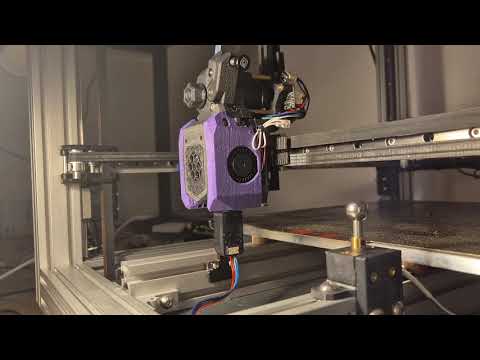
What you need
- A toolchanger running Kalico or Klipper.
- An LDC1612 board (e.g. BTT Eddy Coil/Duo/Usb or Cartographer flashed with Klipper firmware) mounted to the bed, coil facing up.
- For Z offsets: a contact switch (sexbolt, sexball, any fixed Z endstop).
- Your own toolchange and offset-apply gcode to change tools and apply offsets. This plugin is universal and it is not targeting any specific toolchange plugin.
How accurate is it?
These numbers come from my printer, a Voron 2.4 with StealthChanger and a BTT
Eddy Coil, measured with EDDY_REPEATABILITY.

Getting started
- Wire up the eddy coil. See your probe's manual.
- Mount the Eddy Coil Sensor to the bed with the coil facing up. BTT Eddy Mount.stl can be used for BTT Eddy probes.
- Install the plugin, see Install.
- Add the config, see Required.
- Run
EDDY_QUERYto check the wiring before anything moves. - Run
LDC_CALIBRATE_DRIVE_CURRENT CHIP=eddy_tool_calibration. Only needed on non-BTT EDDY boards. - Jog the nozzle over the coil until the paper drags on the coil top face,
then put the X, Y and Z position into
coil_x,coil_yandcoil_z. - Run
EDDY_LOCATE, and put the values intocoil_xandcoil_y. - For Z offsets (Optional): jog the nozzle over the contact switch (Sexball, Sexbolt or any other fixed mounted z homing switch), put those values
into
switch_x,switch_yandswitch_probe_z_start, and setcalibrate_z: True. - For Z offsets (Optional): Run
EDDY_CALIBRATE_Zonce per tool. Rerun it after a nozzle change. - Run
EDDY_CALIBRATE_OFFSET. - Run
EDDY_REPEATABILITY T=0 RUNS=5 CYCLES=3to check the numbers are stable.
Install
Requires Kalico or stock Klipper v0.13.0 or newer, an LDC1612 board reachable over I2C (e.g. BTT Eddy Coil/Duo/Usb or Cartographer flashed with Klipper firmware) and Python 3 with no third-party packages.
cd ~
git clone https://github.com/jaak0b/kalico-eddy-offset-calibration
sh ~/kalico-eddy-offset-calibration/install.sh
sudo service klipper restart
Update manager entry for moonraker.conf:
[update_manager eddy_tool_calibration]
type: git_repo
path: ~/kalico-eddy-offset-calibration
origin: https://github.com/jaak0b/kalico-eddy-offset-calibration
primary_branch: main
is_system_service: False
Config reference
Uncommented options are required and have no default, everything commented out may be left out. The blocks below are all parts of the same [eddy_tool_calibration] section.
Required
[eddy_tool_calibration]
i2c_software_scl_pin:
i2c_software_sda_pin:
#   The SCL and SDA pins of the software i2c bus the LDC1612 chip is wired
#   to. This parameter must be provided.
coil_x:
coil_y:
#   Approximate machine X and Y (in mm) of the coil center. This parameter
#   must be provided.
coil_z:
#   Machine Z (in mm) of the coil top face. This parameter must be
#   provided.
coil_inner_diameter:
#   Bore (in mm) of the sensing coil. Must be greater than 0. It sets the
#   default fit_window_radius and scan_length. This parameter must be
#   provided.
Toolchanger
Both tool_count and toolchange_gcode are needed only to run a calibration command without T=. With toolchange_gcode set, both calibration commands mount the tool they are about to work on, with T= as well as without it; without it they work on whatever tool is already mounted. Every non-baseline result is passed through apply_offsets_gcode as the run proceeds.
#tool_count:
#   The number of tools on the machine, 1 to 16. Tools are T0 through
#   T(tool_count-1) with no gaps.
#toolchange_gcode:
#   The gcode that mounts a tool, as a template with {tool} bound to the
#   tool number.
#apply_offsets_gcode:
#   The gcode that applies a measured offset, as a template with {tool},
#   {offset_x} and {offset_y} bound, and {offset_z} bound as well when
#   calibrate_z is True. The default is to only report the offsets.
#tool_extruders:
#   Comma separated heater section names, one per tool, in tool number
#   order. Names are resolved at startup, so a name that does not exist is
#   a startup error. The default is to assume T0 uses extruder, T1 uses
#   extruder1 and so on.
Z offset via the contact switch
[!NOTE] Z offset means a tool's nozzle offset in Z relative to T0.
[!IMPORTANT] The options below
calibrate_zare ONLY required whencalibrate_zis True.
[!IMPORTANT] When
calibrate_zis True,EDDY_CALIBRATE_Zmust be run at least once, otherwiseEDDY_CALIBRATE_OFFSETwill refuse to measure the Z offset.
#calibrate_z: False
#   Set to True to measure Z. When set to True, `EDDY_CALIBRATE_Z` must be
#   run at least once.
#   The default is False.
switch_pin:
#   The endstop pin the contact switch is wired to. The switch itself is a plain
#   normally-open endstop switch; sexbolt and sexball style Z endstops work
#   well. The pin may be shared with an existing
#   [tools_calibrate] section.
#   This parameter must be provided.
switch_x:
#   The machine X position (in mm) the nozzle presses the switch at.
#   This parameter must be provided.
switch_y:
#   The machine Y position (in mm) the nozzle presses the switch at.
#   This parameter must be provided.
switch_probe_z_start:
#   The machine Z position (in mm) where each press starts from. Set it just above the
#   switch.
#   This parameter must be provided.
#switch_probe_speed: 5.0
#   Speed (in mm/s) of a downward press onto the switch. The default is
#   5.0mm/s.
#switch_probe_lift_speed:
#   Speed (in mm/s) of the retract between presses. The default is
#   switch_probe_speed.
#switch_probe_max_travel: 4.0
#   Distance (in mm) a press may travel down before the run is reported as
#   a missing trigger. The default is 4.0mm.
#switch_probe_sample_retract_dist: 2.0
#   Distance (in mm) the nozzle retracts after each press. Each press
#   starts from where the previous one retracted to, so this must be less
#   than switch_probe_max_travel. The default is 2.0mm.
#switch_probe_tolerance: 0.020
#   Distance (in mm) the three counted presses may disagree by before the
#   probing is reported as failed. The default is 0.020mm.
#calibration_temp: 150.0
#   Nozzle temperature (in Celsius) that every calibration measurement is
#   taken at. It must be above 0 when calibrate_z is True. The default is
#   150.0.
#calibration_temp_band: 2.0
#   Band (in Celsius) around the target temperature a nozzle has to read
#   within before the settle dwell starts. It applies both ways, so a tool
#   that has to cool only has to fall inside it. The default is 2.0.
#calibration_settle_time: 30.0
#   Dwell (in seconds) after a tool reaches the band, before measuring.
#   Both calibration commands dwell the same time, so both measure the
#   same thermal state. The default is 30.0 seconds.
#z_start: 2.5
#   Height (in mm) above the coil top face the downward Z move starts
#   from. The default is 2.5mm.
#z_stop: 0.5
#   Height (in mm) above the coil top face the downward Z move ends at.
#   Must be above the face, and below z_start. The default is 0.5mm.
#z_step: 0.05
#   Step size (in mm) of the downward Z move. Must be greater than 0, and
#   must divide the span from z_start to z_stop into a whole number of
#   steps. The default is 0.05mm.
Sensor hardware
#i2c_address:
#i2c_mcu:
#i2c_bus:
#i2c_speed:
#   The remaining i2c settings for the LDC1612 chip. See the "common I2C
#   settings" section of Kalico's Config_Reference.md for a description of
#   these parameters. The chip's factory address is 42 decimal (0x2A).
#intb_pin:
#   The MCU gpio pin connected to the LDC1612 sensor's INTB pin, if it is
#   broken out. The default is to not use the INTB pin.
#frequency:
#   The external clock frequency (in Hz) fed to the LDC1612 CLKIN pin,
#   accepted from 2000000 to 40000000. It requires Kalico from March 2026,
#   or stock Klipper. The default is 12000000, which is correct for the
#   BTT Eddy family.
#reg_drive_current:
#   The LDC1612 DRIVE_CURRENT0 register value, 0 to 31. The default is 15,
#   which suits the BTT Eddy coil probe. For any other coil determine the right value with
#   `LDC_CALIBRATE_DRIVE_CURRENT CHIP=eddy_tool_calibration` and store the
#   printed value with SAVE_CONFIG. If a scan fails with a sensor
#   amplitude error ("Eddy current sensor error"), raise this value by one
#   and retry.
Scan and fit tuning
#scan_height: 1.0
#   Height (in mm) above the coil top face the XY scan passes run at. Must
#   be above the face and below z_start. The default is 1.0mm.
#scan_safe_z: 2.0
#   Extra clearance (in mm) added above the scan height for travel moves.
#   Must be greater than 0. The default is 2.0mm.
#scan_speed: 4.0
#   Speed (in mm/s) of an XY scan pass. Lower it if a pass returns fewer
#   than samples_min samples. The default is 4.0mm/s.
#scan_length:
#   Length (in mm) of an XY scan pass. The default is 1.5 times
#   coil_inner_diameter: 12.0 mm for the 8 mm BTT Eddy Coil bore, 3.0 mm
#   for the 2 mm Little Crab bore.
#locate_scan_length:
#   Length (in mm) of the coarse EDDY_LOCATE pass. The default is three
#   times scan_length.
#travel_speed: 100.0
#   Speed (in mm/s) of XY travel moves between passes. The default is
#   100.0mm/s.
#z_speed: 10.0
#   Speed (in mm/s) of every Z leg except the switch presses, which use
#   switch_probe_speed and switch_probe_lift_speed. The default is
#   10.0mm/s.
#scan_angles: 45, 135
#   Comma separated scan directions (in degrees), where 0 runs along X+
#   and 90 along Y+. Two directions at least 30 degrees apart are needed
#   to get both axes. A repeated angle is a config error, and so is a pair
#   of opposite angles when pair_scans is enabled. The default is 45, 135.
#pair_scans: True
#   Set to True to scan the opposite of every configured angle as well and
#   average each pair, which cancels the shift each pass picks up along the
#   direction it travels. Pairing doubles the number of passes. The default
#   is True.
#samples_min: 100
#   Minimum usable samples per scan pass, at least 3. A pass below it is
#   reported as an error. The default is 100.
#query_time: 0.5
#   Time (in seconds) EDDY_QUERY collects samples for, at the driver's
#   250 Hz rate (400 Hz on Klipper master). The default is 0.5 seconds,
#   about 125 samples.
#freq_min: 1000000.0
#   Frequency (in Hz) below which samples are discarded as startup or
#   noise readings. The default is 1000000.0.
#edge_margin: 0.15
#   Fraction of each pass treated as its edge, above 0 and below 0.5. The
#   edges are left out of the search for the peak, and are used to tell
#   whether the pass peaks up or down. The default is 0.15.
#fit_window_radius:
#   Half width (in mm) of the sample window either side of the peak that
#   the curve is fitted to. The default is half of coil_inner_diameter.
#fit_sigma_fraction: 0.5
#   Standard deviation of the fit's weighting, as a fraction of the fit
#   window. It makes samples near the peak count for more than samples at
#   the window's edge. The default is 0.5.
#fit_vertex_limit: 0.5
#   Maximum distance between the fitted peak and the peak sample, as a
#   fraction of the fit window. A fit landing beyond it is reported as
#   failed rather than pulled back into range. The default is 0.5.
#center_tolerance: 0.05
#   Distance (in mm) two consecutive rounds of an XY measurement may
#   differ by before the measurement stops and reports the last round's
#   center. Rounds that differ by more are followed by another refine
#   round. Must be greater than 0. The default is 0.05mm.
#max_rounds: 6
#   Most scan rounds, counting the coarse round, one XY measurement runs
#   before it is reported as not settled. At least 2. The default is 6.
Logging
#save_history: True
#   Set to True to append every completed measurement of a tool to
#   history_T<n>.csv in log_dir: the UTC timestamp, the command, the
#   fitted center, the offsets, the session of the baseline they were
#   measured against, the Z crossing and the height where the switch
#   clicks, the nozzle temperature the run was held at, the nozzle reading
#   observed while it ran, and the sample count. The default is True.
#save_csv: False
#   Set to True to write every scan pass's raw samples to a CSV file for
#   offline review. The default is False.
#log_dir: EddyToolCalibration/logs
#   Directory the drift logs and the repeatability study files are written
#   to, read against the printer config directory unless it is an absolute
#   path. These are the durable record. The default is
#   EddyToolCalibration/logs.
#csv_dir: EddyToolCalibration/data
#   Directory the raw scan dumps of save_csv are written to, read against
#   the printer config directory unless it is an absolute path. These are
#   working files, meant to be cleared once they have been looked at. The
#   default is EddyToolCalibration/data.
Integration with Klipper Toolchanger plugin
Append the following config reference to [eddy_tool_calibration] for integration with viesturz's klipper-toolchanger
toolchange_gcode:
    T{tool}
apply_offsets_gcode:
    SET_TOOL_PARAMETER T={tool} PARAMETER=gcode_x_offset VALUE={offset_x}
    SET_TOOL_PARAMETER T={tool} PARAMETER=gcode_y_offset VALUE={offset_y}
    SET_TOOL_PARAMETER T={tool} PARAMETER=gcode_z_offset VALUE={offset_z}
Append the following config reference to [eddy_tool_calibration] for integration with klipper-toolchanger-hard
toolchange_gcode:
    T{tool}
apply_offsets_gcode:
    SET_TOOL_OFFSET T={tool} X={offset_x} Y={offset_y} Z={offset_z}
Supported hardware
Any eddy style probe with an LDC1612 works as long as it is flashed with stock Klipper firmware and reachable over I2C.
| Board | |
|---|---|
| BTT Eddy Coil | Conected directly to the mainboard or a toolheadboard |
| BTT Eddy USB | Expected to work unmodified; I have not tried one. Its RP2040 runs standard Klipper firmware as a second MCU |
| BTT Eddy Duo | Expected to work in USB mode only. |
| chengxg "Little Crab" dual-coil board | The board this plugin's algorithm comes from; a sharper XY signal than the BTT coils. Mine are still being assembled, so unmeasured here |
| Cartographer | Only works if the board is flashed with Klipper firmware. Cartographer's own firmware will not work |
BTT Eddy Coil
[eddy_tool_calibration]
i2c_mcu: mcu
i2c_software_scl_pin:
i2c_software_sda_pin:
i2c_address: 42
reg_drive_current: 15
coil_inner_diameter: 8.0
BTT Eddy USB/DUO
[mcu eddy]
serial: /dev/serial/by-id/usb-Klipper_rp2040_XXXXXXXXXXXX-if00

[eddy_tool_calibration]
i2c_mcu: eddy
i2c_bus: i2c0f
i2c_software_scl_pin:
i2c_software_sda_pin:
i2c_address:
reg_drive_current: 15
coil_inner_diameter: 8.0
Little Crab
[eddy_tool_calibration]
i2c_mcu: mcu
i2c_software_scl_pin:
i2c_software_sda_pin:
frequency: 40000000
coil_inner_diameter: 2.0
reg_drive_current: 22
i2c_speed: 400000
i2c_address: 42
scan_speed: 4.0
scan_length: 4.0
Sources: upstream repository, EasyEDA project.
Commands
[!NOTE]
T=takes one tool number or a comma separated list with no spaces (T=0,1,2). LeavingT=out runs every tool and needstool_count; any run covering more than one tool needstoolchange_gcode.
EDDY_QUERY
EDDY_QUERY: Print statistics of the sensor frequency over query_time seconds without motion. Use it as a wiring check.
LDC_CALIBRATE_DRIVE_CURRENT
LDC_CALIBRATE_DRIVE_CURRENT CHIP=eddy_tool_calibration prints the correct reg_drive_current for the connected sensor.
EDDY_LOCATE
EDDY_LOCATE [DEBUG=1]: Measures the coil center precisely and stages it as coil_x and coil_y.
EDDY_CALIBRATE_Z
[!NOTE] Requires
calibrate_z: True
EDDY_CALIBRATE_Z [T=<list>] [DEBUG=1]: Correlates the sensor's readings with the nozzle's actual Z height using a z endstop/microswitch.
Must be run once per tool. Rerun the command when the toolhead (e.g. the nozzle, hotend) changes.
Results are written to calibration_state.json directly.
EDDY_CALIBRATE_OFFSET
[!NOTE] T0 is always measured after a Klipper restart.
EDDY_CALIBRATE_OFFSET [T=<list>] [DEBUG=1]: Measure the listed tools offset relative to T0. Prints the offset in the console. Runs apply_offsets_gcode when provided.
EDDY_REPEATABILITY
EDDY_REPEATABILITY T=<tool> RUNS=<n> CYCLES=<n> [SKIP_Z=1] [DEBUG=1]: Measures offset calibration repeatedly.
RUNS=<n> measurements taken back to back without touching the tool. Shows the measurement's own noise.
CYCLES=<n> how many times to swap the tool away and back before taking another set of runs, needs tool_count and toolchange_gcode, without them nothing is docked and the summary says so.
SKIP_Z=0 measures Z as well, and needs the tool's EDDY_CALIBRATE_Z result. The default is 1, XY only.
Reading the results from a macro
The plugin publishes printer.eddy_tool_calibration (keys are tool
numbers as decimal strings):
{% set eddy = printer.eddy_tool_calibration %}
{% if eddy.tools['1'] is defined and eddy.tools['1'].offset_x is not none %}
  SET_GCODE_OFFSET X={eddy.tools['1'].offset_x} Y={eddy.tools['1'].offset_y}
{% endif %}
| Key | Meaning |
|---|---|
calibrate_z, tool_count | the config section's values; tool_count null when unset |
baseline_tool | tool the offsets are measured against, null until a baseline exists |
session_id | rises by one each time a baseline replaces the previous one |
anchors | what EDDY_CALIBRATE_Z stored, per tool; survives a restart. Each carries anchor_height (mm above the height where the switch clicks), anchor_frequency (Hz), setpoint_temperature (the temperature later runs heat to), observed_temperature, trigger_z (machine Z where the switch clicks) and updated (UTC) |
tools | this session's measurements; a baseline replacement removes the measurements compared against the old one, so an offset here is never compared against a baseline that has moved. Each carries offset_x/y/z (mm; all null for the baseline itself, offset_z null when Z was not measured, and a null is never a zero), center_x/y (machine coordinates), z_crossing (machine Z where the downward move reached anchor_frequency), session_id and measured_time (host monotonic clock) |
Measuring before each print
[!IMPORTANT] Requires all Toolchanger config options to be set.
[!IMPORTANT] The macro assumes that your slicer passes tool temperature as
{if is_extruder_used[0]}T0_TEMP={first_layer_temperature[0]}{endif}(Example for T0, use 1 for T1, 2 for T2,..) in your slicers machine start-gcode.
To calibrate each used tool before a print use the below macro and call EDDY_CALIBRATE_USED_TOOLS {rawparams} from your print_start macro.
[gcode_macro EDDY_CALIBRATE_USED_TOOLS]
description: Calibrate offsets for the tools this print actually uses
gcode:
    {% set sx = printer.toolhead.position.x %}
    {% set sy = printer.toolhead.position.y %}
    {% set sz = printer.toolhead.position.z %}
    {% set used = [] %}
    {% for key in params %}
        {% if key.startswith('T') and key.endswith('_TEMP') and key[1:-5].isdigit() %}
            {% set _ = used.append(key[1:-5]|int) %}
        {% endif %}
    {% endfor %}
    {% if used|length > 1 %}
        {% set tools = ([0] + used)|unique|list|sort %}
        EDDY_CALIBRATE_OFFSET T={tools|join(',')}
        G28 Z
    {% endif %}
    G90
    G1 X{sx} Y{sy} F6000
    G1 Z{sz} F1200
License
GNU GPLv3, see LICENSE. The algorithms are reimplemented from
chengxg's GPLv3
tool_eddy_calibration
rather than copied from it, which makes this a derivative work under the
same license. His original file is kept unmodified in reference/.